Hungarian Parliament Building History, From 1880 to Today
Hungarian Parliament building history runs from an 1880 decision to build a permanent home for the nation's parliament, through 19 years of construction, to the Holy Crown's arrival under the dome in 2000. This page tells that story in order: the design competition and Imre Steindl, the build and the 1896 millennium, the 20th century on Kossuth Square from the 1912 shooting to the 1989 republic, the crown's road back, UNESCO listing and the restored square, and how to see all of it on a tour. For tickets and booking options, start with HungarianParliamentTickets.com.
Quick answer
The Hungarian Parliament Building was designed by Imre Steindl after an 1883 international competition and built from 1885 to 1904. It was inaugurated in 1896 for the country's millennium and is the largest building in Hungary. Three historic moments are visible today: the balcony where the republic was declared in 1989 faces Kossuth Square, the memorial to the Bloody Thursday massacre of 1956 sits underground in the square's southern ventilation tunnel, and the Holy Crown has stood in the Dome Hall since 1 January 2000.
Key takeaways
- Steindl's neo-Gothic design won the 1883 competition partly because it looked like Westminster.
- Two moments changed Hungary on this square. Read about 1956 and 1989.
- The Holy Crown came back from Fort Knox in 1978 and has sat in the Dome Hall since 1 January 2000.
- The Parliament entry ticket with audio guide includes a downloadable audio walk around Kossuth Square covering the Bloody Thursday story.
- The Grand City Tour with Parliament visit pairs the interior with a live guide and the rest of Budapest.
The Decision and the Design Competition
A capital only 7 years old needed a building to match its new status, and the decision to build one set off a contest that shaped the whole square.
From Three Cities to One Parliament
Budapest was united from three cities, Buda, Óbuda and Pest, in 1873. Seven years later, in 1880, the Diet resolved to build a new, permanent parliament building expressing the sovereignty of the nation, through Act LVIII of 1880. It was planned to face the Danube.
There had been an earlier attempt. A competition for a parliament building was announced in 1844, but the 1848-49 revolution and war halted the judging and most of its plans were lost.
Nineteen Designs, Four Prizes
An international design competition followed. Its deadline passed on 1 February 1883 with 19 designs submitted, and four equal prizes were awarded. Imre Steindl's neo-Gothic design was chosen to be built.
The runners-up did not disappear. Plans by two other competitors were later realized in the buildings facing the Parliament across Kossuth Square: the Ministry of Agriculture and the Palace of Justice, which for many years housed the Ethnographic Museum. Stand anywhere in the middle of the square today and you are looking at three entries from the same 1883 competition at once.
Why It Looks Like Westminster
One reason Steindl's plan was chosen was its strong resemblance to the Palace of Westminster in London. Leading Hungarian politicians wanted the building to symbolize the country's commitment to Western Europe, especially Britain, which was the political role model of Hungarian reformers. The resemblance is real.
The Palace of Westminster had been rebuilt after a fire in 1834, with construction starting in 1840 and lasting about 30 years, so London's new parliament was only a few decades old when Budapest held its contest. Steindl also drew on the Gothic Vienna City Hall, and the Renaissance Revival dome follows the Maria vom Siege church in Vienna.
Source: Wikipedia, Hungarian Wikipedia (Országház), Wikipedia, Palace of Westminster, Wikipedia, Imre Steindl, Kata Budapest.
Building It, 1885-1904
Construction took 19 years, outlived its architect, and finished as the largest building in the country.
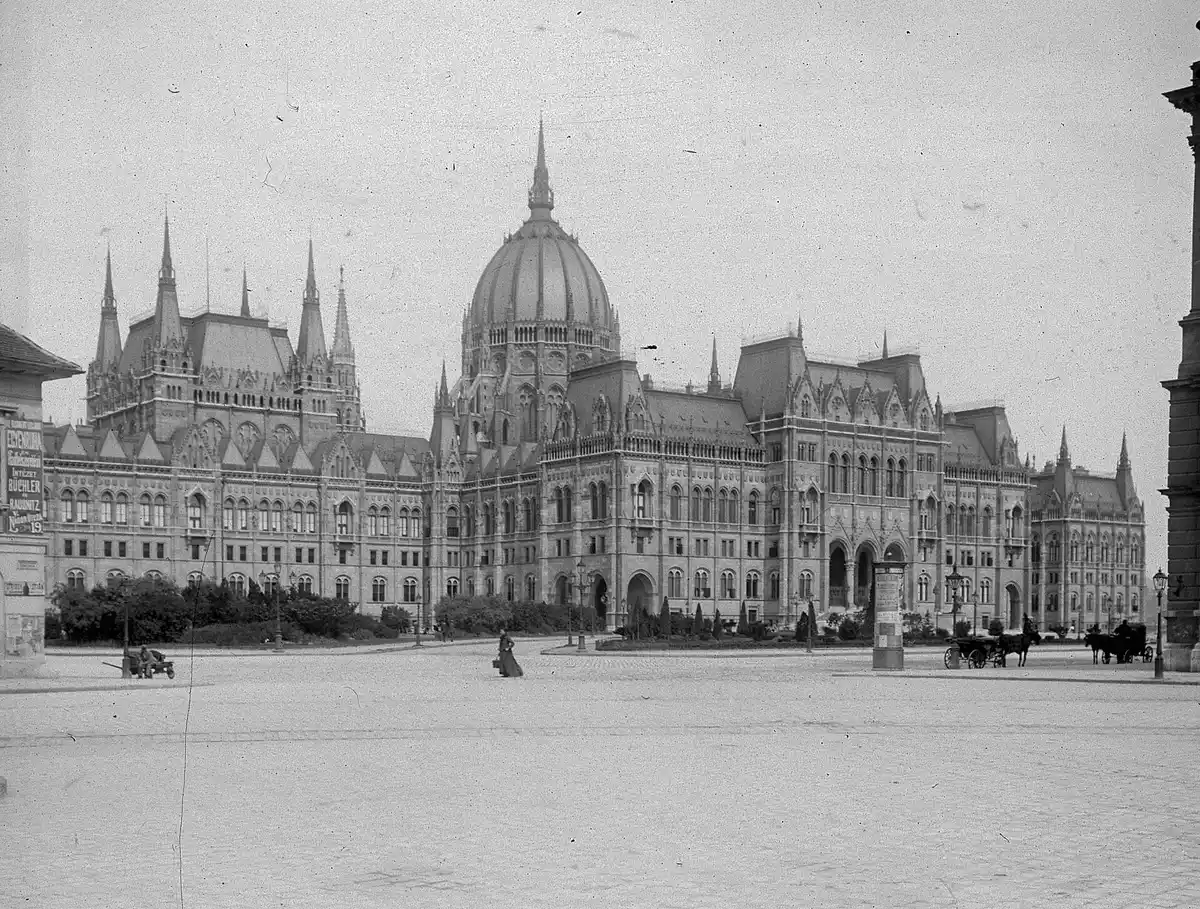
The Parliament from the square, photographed around 1903, a year before completion. Photo: Fortepan, donor Frigyes Schoch, public domain, via Wikimedia Commons
First Spade to the Millennium
The first spade went into the ground on 12 October 1885. At the busiest time about 1,000 people worked on the building. The deadline that drove them was symbolic.
The country would celebrate the presumed 1,000th anniversary of its conquest in 1896, and the Parliament was inaugurated that year. On 8 June 1896 the National Assembly held its first session in the still unfinished building. So parliament first met here eight years before the building was complete.
The Number 96
The number 96 runs through the building on purpose. The height of 96 m alludes to the millennium of 1896 and to 896, when the Hungarians settled in the Carpathian Basin. The main staircase is also said to have 96 steps.
The figure became a rule for the city skyline. For more than a hundred years no building in central Budapest was taller than 96 m, the height of the Parliament and St. Stephen's Basilica. The MOL Campus tower was the first to go higher.
The Architect Who Never Saw It Finished
Imre Steindl, born 29 October 1839 in Pest, went blind before the building was completed and died in Budapest on 31 August 1902. The keys of the building were handed over that same year. Full completion came in 1904, and the scale is hard to picture.
About 40 million bricks, half a million precious stones and 40 kg of gold went into it. The building is 268 m long and 123 m wide, with 691 rooms, 29 staircases, 10 courtyards, 13 elevators and 27 gates, and it has been the largest building in Hungary since completion.
Source: Wikipedia, Hungarian Wikipedia (Országház), Kata Budapest.
Hungarian Parliament Building History: Key Dates
The dates in order, with what you can see of each today.
-
1873
Budapest united
Buda, Óbuda and Pest merged into one capital. The new city needed buildings to match, and the parliament came first among them.
-
1880
The Diet resolves to build
Act LVIII of 1880 called for a permanent parliament expressing the sovereignty of the nation, facing the Danube. An 1844 competition had been halted by the 1848-49 war, and most of its plans were lost.
-
1883
Steindl wins the competition
19 designs were submitted by 1 February 1883 and four equal prizes were awarded. Imre Steindl's neo-Gothic plan was chosen, partly for its resemblance to Westminster.
-
1885
Construction begins
Work started on 12 October 1885. About 1,000 people worked on the site at the busiest time.
-
1896
Millennium inauguration
The building was inaugurated for the presumed 1,000th anniversary of the conquest. The National Assembly held its first session inside on 8 June 1896, with the building still unfinished.
-
1902
Keys handed over, architect dies
The keys were handed over in 1902. Imre Steindl, who had gone blind before completion, died on 31 August that year.
-
1904
Fully completed
The building was finished in 1904, with about 40 million bricks and 40 kg of gold in it. At 268 m by 123 m with 691 rooms it is the largest building in Hungary.
-
1912
Shots in the chamber
Opposition MP Gyula Kovács fired at Speaker István Tisza during a session, missed, and survived his own shot. The bullet marks are still in the working chamber, which is not on the visitor route.
-
1927
The square is renamed
The square had been called Tömő tér from 1853 to 1898, then Országház tér. It was renamed after Lajos Kossuth in 1927.
-
1945
The crown leaves Europe
At the end of World War II the crown jewels were taken west. They were recovered in Mattsee, Austria, on 4 May 1945, and were then held for much of the Cold War at Fort Knox in the United States.
-
1956
Bloody Thursday
Students called people to the Parliament on 23 October 1956. On 25 October a crowd on Kossuth Square came under Soviet fire, with estimates of the dead ranging from 75 to 1000. The memorial today is underground in the square's southern ventilation tunnel.
-
1978
The crown returns
The Holy Crown was returned to Hungary in Budapest on 6 January 1978 by US Secretary of State Cyrus Vance, on President Jimmy Carter's order. It was then shown at the Hungarian National Museum.
-
1987
World Heritage listing
The Banks of the Danube and the Buda Castle Quarter were listed as a World Heritage site, and the Parliament stands on that riverbank.
-
1989
The republic is declared
On 23 October 1989 Mátyás Szűrös declared the Hungarian Republic from the balcony of the Parliament facing Kossuth Square. You can look up at that balcony from the square today.
-
1990
The red star comes down
A red star had stood on top of the dome during the People's Republic. It was removed in 1990 after the fall of communism.
-
2000
The crown moves in
On 1 January 2000 the Holy Crown was moved from the National Museum to the Parliament, with the sceptre, orb and coronation sword. It is on display in the central Dome Hall.
-
2002
Andrássy Avenue joins the list
Andrássy Avenue was added to the World Heritage site in 2002. 1987 remains the year the Parliament itself was included.
-
2012-2014
The square restored
Kossuth Square closed in 2012 and reopened in 2014 traffic-free, restored to its pre-1944 look. The Tisza and Andrássy memorials were reconstructed, the 1956 memorial was created in the southern ventilation tunnel, and the underground Visitor Centre opened.
Source: Wikipedia, Hungarian Wikipedia (Országház), Wikipedia, Kossuth Lajos Square, Wikipedia, Holy Crown of Hungary, Wikipedia, Hungarian Revolution of 1956, Kata Budapest.
Two Chambers, a World War and a Red Star
The 20th century left its marks inside the building and on its dome, and some of them are still there to find.
Shots in the Chamber, 1912
In 1912 opposition MP Gyula Kovács fired a pistol at the Speaker, István Tisza, during a session. He missed, turned the gun on himself and survived. The bullet marks can still be seen in the chamber.
That chamber is the working one, where the National Assembly sits today, so it is not on the visitor route. The traces are still in a room parliament still uses.
From Two Houses to One
The building was designed for a two-chamber parliament. It has two identical chambers either side of the Dome Hall, built for the Lower House and the Upper House. Since World War II the legislature has been unicameral.
The National Assembly meets in the old Lower House, and the Upper House hall is used for ceremonies, conferences and guided tours. So the hall visitors walk through on the tour is the former Upper House, the twin of the working chamber.
The Crown Leaves, the Star Arrives
At the end of World War II the crown jewels were taken west. They were recovered in Mattsee, Austria, on 4 May 1945, and were held for much of the Cold War at the United States Bullion Depository at Fort Knox. During the People's Republic of Hungary a red star stood on top of the dome.
It was removed in 1990 after the fall of communism, so the silhouette over the Danube today is the one Steindl designed.
Source: Kata Budapest, Wikipedia, Wikipedia, Holy Crown of Hungary, Finding the Universe.
1956 and 1989 at Kossuth Square
Twice in 33 years the square in front of the Parliament decided the country's story, in 1956 and again in 1989.
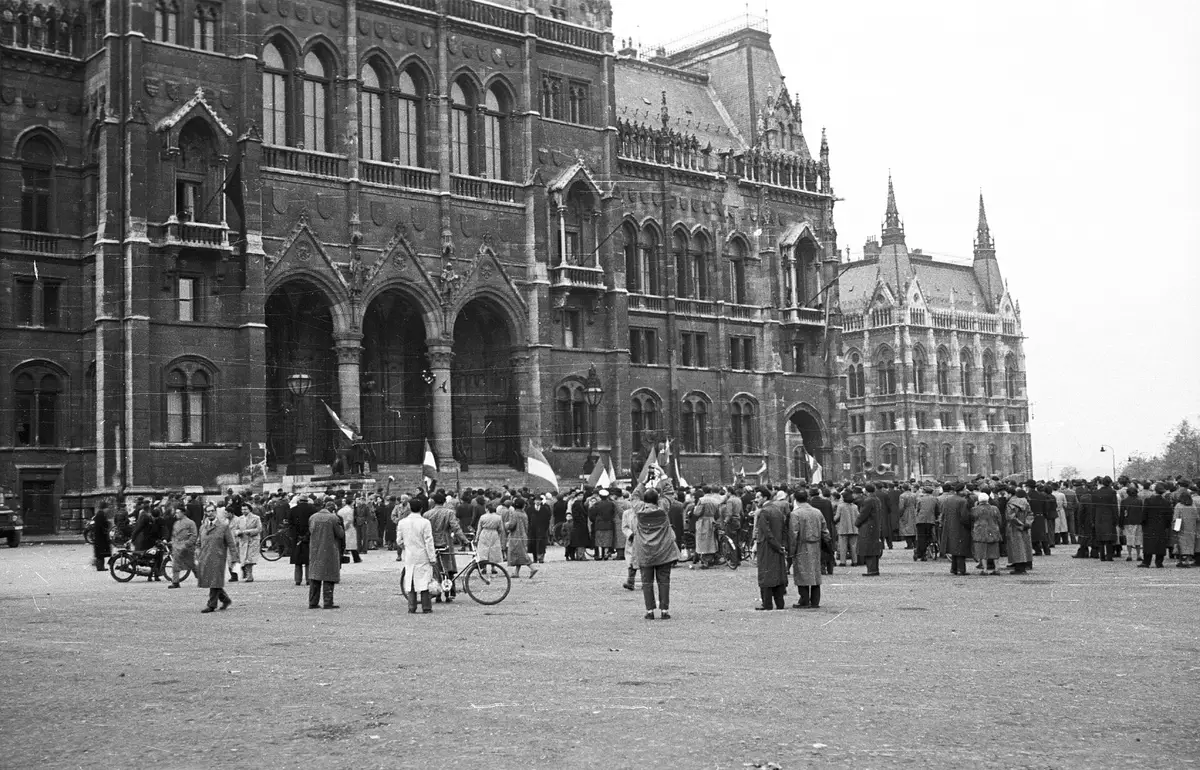
Demonstrators in front of the Parliament on Kossuth Square in 1956. Photo: Fortepan, donor Gyula Nagy, CC BY-SA 3.0, via Wikimedia Commons
23 and 25 October 1956
On 23 October 1956 university students appealed to the people of Budapest to join them at the Parliament Building. Two days later, on 25 October, a crowd gathered in Kossuth Square in front of the Parliament. Warning shots caused panic, and a Soviet tank fired aimed shots at demonstrators taking cover.
Estimates of the dead range from 75 to 1000 and are still disputed. Hungarians call the day Bloody Thursday. The revolution was crushed by Soviet troops in November 1956.
The memorial to the victims is not up on the square. It is underground, in the southern ventilation tunnel, created during the 2012-2014 restoration, and you can visit it on foot from the square.
23 October 1989
On 23 October 1989, the anniversary of the 1956 revolution, Mátyás Szűrös declared the Hungarian Republic from the balcony of the Parliament facing Kossuth Lajos Square. The red star came down from the dome in 1990. To see this piece of history, stand in the square and look up at the balcony, then walk down into the tunnel memorial for 1956.
Source: Wikipedia, Hungarian Revolution of 1956, Wikipedia, Wikipedia, Kossuth Lajos Square.
The Holy Crown's Road to the Dome Hall
The crown spent World War II and the Cold War far from Budapest before it came to rest under the dome.
Fort Knox to Budapest, 1978
On 6 January 1978, by order of President Jimmy Carter, US Secretary of State Cyrus Vance returned the Holy Crown to Hungary in Budapest. After its recovery at Mattsee in 1945 the crown had been held at Fort Knox for most of the Cold War. Back in Budapest it was shown at the Hungarian National Museum, and it stayed there until the move to the Parliament.
Under the Dome Since 2000
On 1 January 2000 the Holy Crown was moved from the National Museum to the Parliament, together with the sceptre, orb and coronation sword. It is on display in the central Dome Hall, the hall at the center of Steindl's plan. The coronation mantle stayed at the National Museum.
Guards stand beside the crown, and photography is not allowed in that hall, so plan to look rather than shoot. The Dome Hall is a stop on every guided visit, and the rest of the route is described in inside Hungarian Parliament.
Source: Wikipedia, Holy Crown of Hungary, Finding the Universe.
UNESCO and the Restored Kossuth Square
The riverbank has been World Heritage since 1987, and the square in front of the building was returned to its historic look between 2012 and 2014.
A World Heritage Riverbank
The Parliament stands in the World Heritage site named Budapest, including the Banks of the Danube, the Buda Castle Quarter and Andrássy Avenue. The Banks of the Danube and the Buda Castle Quarter were listed in 1987, and Andrássy Avenue was added in 2002. Two dates, two different parts of the city.
So if you are asked whether the Parliament is a UNESCO site, the answer is yes, and the year to give for the Parliament is 1987, since 2002 belongs to Andrássy Avenue.
The Square Put Back, 2012-2014
The square's name tracks the building's rise. It was called Tömő tér from 1853 to 1898, because the ground was raised with fill, then Országház tér from 1898, and it was renamed after Lajos Kossuth in 1927. In 2012 the square was closed to restore its original, pre-1944 view, and it reopened in 2014 as a traffic-free zone with a park.
The works added an underground car park, sculptures, and reconstructed memorials of István Tisza and Gyula Andrássy. The memorial to the victims of the 25 October 1956 massacre was created in the southern ventilation tunnel. The underground Visitor Centre also opened in 2014, with a permanent exhibition on 1,000 years of Hungarian legislation, and the reconstruction of the outer facade was completed the same year.
Because of its huge surface and detailed handiwork, the building is almost always under renovation, so expect some scaffolding. Reaching it is easy, and how to get to Hungarian Parliament covers the options.
Source: Kata Budapest, Wikipedia, Kossuth Lajos Square, Hungarian Wikipedia, Budapest by Locals, Wikipedia.
See the History on a Parliament Tour
Both options include the guided visit inside, with the Dome Hall and the Holy Crown. The audio-guide ticket adds a downloadable audio walk around Kossuth Square and its memorials, while the city tour adds a live guide and the rest of Budapest. Times for visits are set out on the opening hours page.
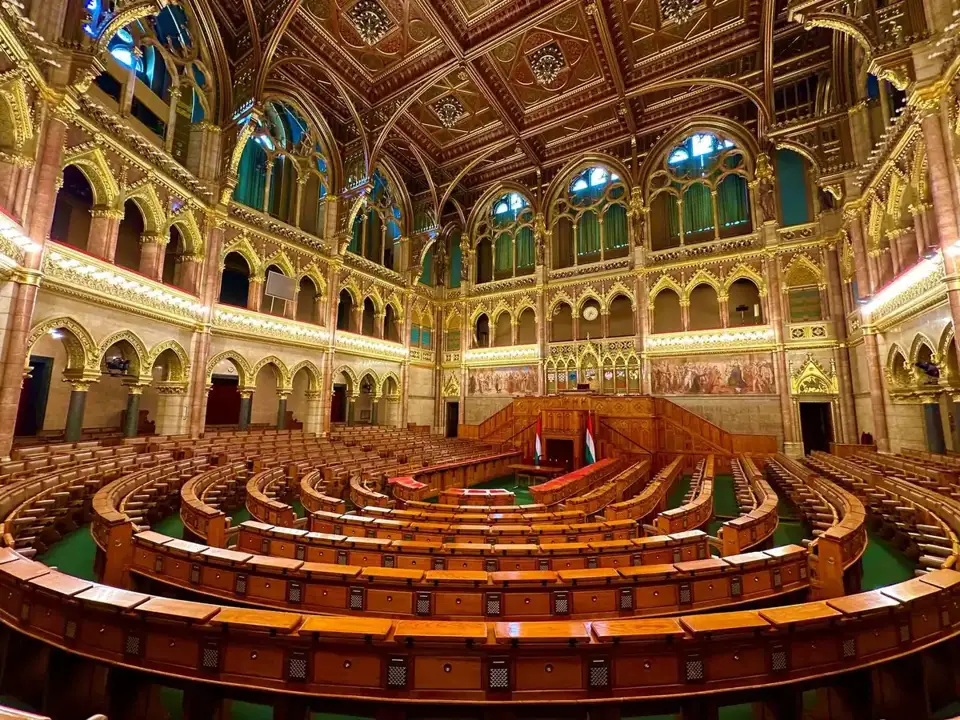 from $51
Budapest: Parliament Building Entry Ticket and Audio Guide
Entry ticket to the Hungarian Parliament with a 45-minute tour inside on a multilingual audio guide, plus an audio walk around Kossuth Lajos tér. Covers the Main Staircase…
- Hungarian Parliament entry ticket included
- 45-minute visit inside with an audio guide in 26 languages, English included
- Audio walk around Kossuth Lajos tér and its memorials
- 15 minutes for check-in and tickets at the Visitor Centre
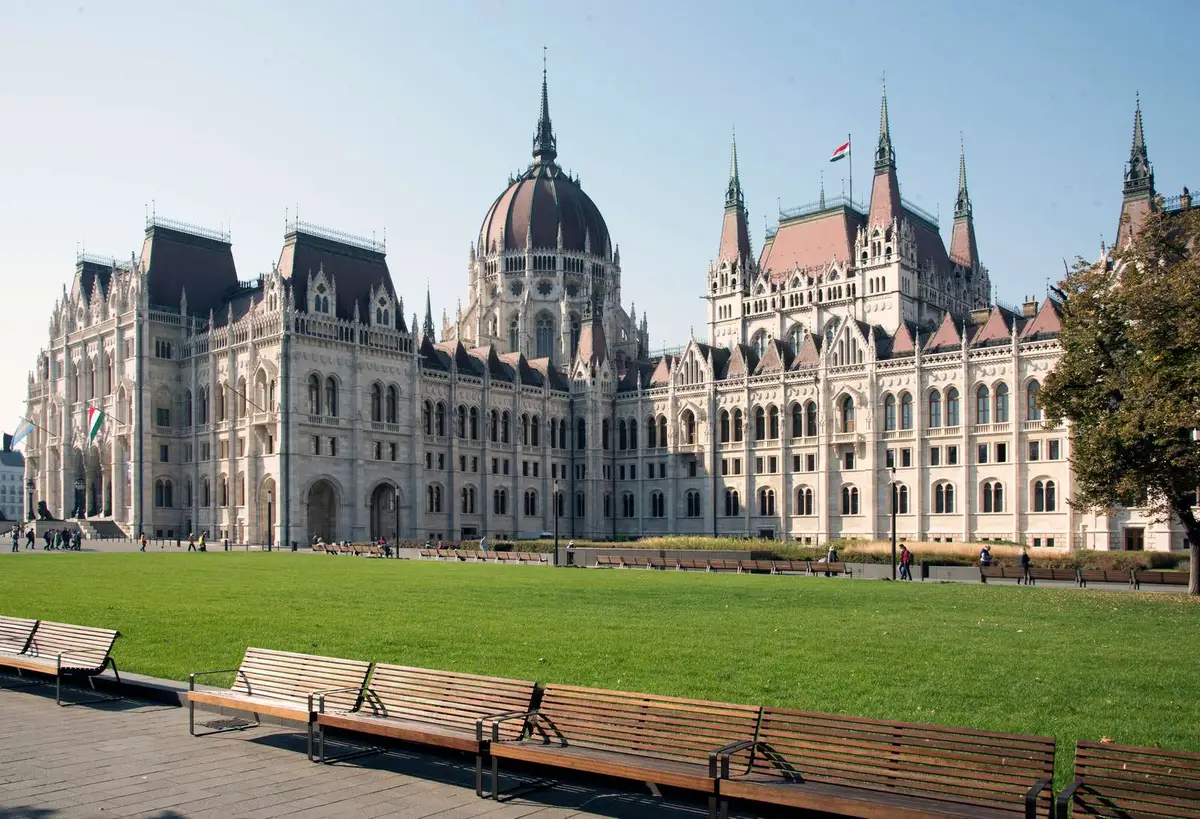 from $73
Budapest: Grand City Tour with Parliament Visit
A 3-hour bus tour of Budapest with a live guide (Castle District walk, Heroes' Square, Andrássy Avenue) that ends with a 1-hour guided visit inside the Parliament. Hotel…
- 1-hour guided visit inside the Parliament, entrance fee included
- 3-hour city tour by bus with a live guide in English, Italian or Spanish
- Short walk in Buda Castle District
- Hotel pickup and drop-off
Hungarian Parliament Building History: Questions
How old is the Hungarian Parliament Building?
The first spade went into the ground on 12 October 1885, and the building was fully completed in 1904. It was used from 1896, when the National Assembly held its first session inside the still unfinished building for the millennium celebrations. So the Parliament is more than 120 years old, with 19 years of construction behind it. You can read the full chronology in the timeline.
Who designed the Hungarian Parliament Building?
Imre Steindl, a Hungarian architect born in Pest in 1839. His neo-Gothic design won the international competition that closed on 1 February 1883, in which 19 designs were submitted and four equal prizes were awarded. Steindl went blind before the building was finished and died in Budapest on 31 August 1902, the year the keys were handed over. Read more about the competition and his influences.
Why is the Hungarian Parliament Building famous?
Three reasons stand out. It is the largest building in Hungary, at 268 m long with 691 rooms, and it was built with about 40 million bricks and 40 kg of gold. It looks like the Palace of Westminster, because Hungarian politicians wanted a symbol of commitment to Western Europe. And it is a working parliament where history happened, from the 1956 killings on the square to the republic declared from its balcony in 1989. See why it resembles Westminster.
Is the Hungarian Parliament Building the biggest in the world?
No. It is one of the largest parliament buildings in the world, but not the largest. What is certain is that it has been the largest building in Hungary since completion, with 268 m of length, 123 m of width, 691 rooms, 29 staircases, 10 courtyards, 13 elevators and 27 gates. The construction numbers behind it are in the construction section. Its 45-minute visitor route covers the highlights, including the Dome Hall with the crown.
What is the oldest parliament building in the world?
Not this one. The Hungarian Parliament was built from 1885 to 1904. Its own model is older: the Palace of Westminster in London was rebuilt after an 1834 fire, with construction starting in 1840, and it still contains the 11th-century Westminster Hall. Budapest tried earlier too, with an 1844 competition that the 1848-49 revolution halted. The timeline sets out every Budapest date in order.
Why does the Hungarian Parliament look like the British Parliament?
Imre Steindl's plan won the 1883 competition partly because of its strong resemblance to the Palace of Westminster in London. Leading Hungarian politicians wanted the building to symbolize the country's commitment to Western Europe, especially Britain, which was the political role model of Hungarian reformers. Two Viennese buildings also left their mark, the Gothic Vienna City Hall and the Maria vom Siege church, whose dome inspired the Renaissance Revival dome. More on this in the design section.
Is the Hungarian Parliament a UNESCO World Heritage Site?
Yes. The Parliament stands in the World Heritage site called Budapest, including the Banks of the Danube, the Buda Castle Quarter and Andrássy Avenue. The Banks of the Danube and the Buda Castle Quarter were listed in 1987, and Andrássy Avenue was added in 2002. So 1987 is the year for the Parliament and 2002 belongs to Andrássy Avenue. Details are in the UNESCO and Kossuth Square section, including the restored square around the building.
Can you see the history on a tour?
Yes. Every guided visit includes the Dome Hall with the Holy Crown, in place there since 2000, plus the halls of the old Upper House. The Parliament entry ticket with audio guide adds a downloadable audio walk around Kossuth Square covering Bloody Thursday and the memorials. The bullet-marked working chamber is not on the route, and slots on popular days go early.